


Should Google be held responsible for all the AI mistakes?

Policies on user liability in the generative search era. Thinking about user liability in the context of generative search.
A recent ruling in Germany that Google may be liable for harmful information created by its AI Overviews has sparked a conversation that's spreading across the globe of how governments will regulate AI in the future. The court has established precedent by describing AI-driven summarizations as Google's own in a way that suggests that the responsibility for the content might be passed on to the platforms that utilize generative AI technologies, according to reports.
The ruling for many is a move towards accountability in the age of the digital world. However, the decision also serves as both a reminder and a call to consider the questions of innovation and feasibility, as well as the future of AI in Europe.
This is a complex policy issue-should a legal liability be associated with the outputs of any probabilistic system when modelled well by and thoroughly under AI providers? The question is not as easy as it sounds.
What sets generative AI apart? What is special about Generative AI?
Unlike conventional software, generative AI systems are designed to interact with a user's data to produce original material.
Conventional programs work based on rules (explicit) and deterministic instructions. They have the same outputs each time they have the same input. There are, however, large language models, and they work differently. They utilize patterns from huge amounts of data to generate answers, predicting the most likely word to follow the last one.
AI generally produces results that are not set in stone, or predictable, but dependent on the odds. It's a less-than-perfect attribute of Google, but not exclusively so. Instead, it shows an intrinsic characteristic of current-generation AI generative technology. Not all information generated by the most sophisticated models is correct, sometimes even made up (this is often called “hallucination”).
It is possible to create an unrealistic expectation if people hope that this is a perfectly accurate system. But that is the dilemma for the policy makers as to whether occasional mistakes are going to implicate in law, especially when there is no technology that would provide certain accuracy of generative output.
From publisher to platform, which is a challenging distinction
The German court's reasoning seems to be that Google's AI Overviews are not for-fire welfare messages, but rather Google's own speech. However, this amounts to controversy.
In the past the search engines were middlemen and not publishers. Their major job has been to coordinate information produced outside the scope of their job description. Although the AI Overviews are new, they rely on information that is present in the entire web. Google might view AI-generated summaries more as a tool of the algorithm than an editorial piece.
Google doesn't manually produce, verify or publish one recommendation for another for each AI-generated answer until the end users see them, unlike regular publishers would do. Responsibility for all output can make it difficult to maintain the very traditional division between automated systems and human editorial work.
The trend towards defining AI-generated content as "platform speech" could impact platforms beyond search engines, including work productivity tools, chatbots, and a wide range of AI-powered services.
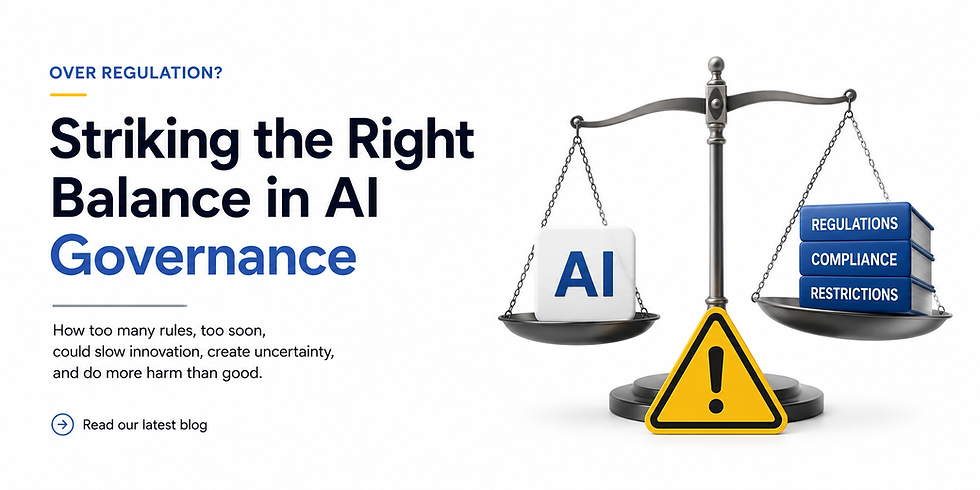
Over-regulation risk
To take digital governance to global stage, the introduction of measures including the AI Act and the Digital Services Act (DSA) in Europe. Over-regulation or watered down regulation also comes at a price, though. One fear is that there will be uncertainty in the regulations.
But anyone using AI's product if they have to assume liability for its work could be less willing to make the investment in new systems in more-regulated businesses. Smaller companies and startups will likely be at especially high risk if they do not have as much compliance capacity as larger technology firms.
This might occur at the expense of limiting competition and innovation and therefore reinforce the dominant companies. The regulator problem is where to balance it so that people aren't at risk, but there aren't laws that are hostile to technology. The twin goals of innovation and accountability can't be at odds.
Shared responsibility arrangements and existing safeguards
Google and other AI developers have already put in place various mitigations to ensure the generation of less damaging outputs. These include content filtering systems, model evaluations, safety test and feedback systems for users.
Further, most AI Overviews include cautions that the answer provided is generative, which can be incorrect. Important information is often reinforced by other sources in order to encourage users to check. Viewed from this angle, multiple responsibilities lie with the actors involved, from the developer to the deployer, from the user to the content creator, in this case.
Given the multifaceted nature of generative AI environments, it would be more fitting to consider a model of shared responsibility rather than assigning sole responsibility to a single platform, rather than the single platform.
In fact, numerous researchers have claimed that the framework of AI governance should be centred not only on the punishment of the harm done after the fact, but also on increasing and promoting good practise in information design, transparency, risk reduction and detection.
Did these risks already get anticipated by EU Frameworks?
The German interpretation also puts in doubt the connection between the judicial orders and European rule.
AI systems must be transparent and subject to risk management and documentation requirements, according to the AI Act. Likewise, systemic threats to very large online platforms are also taken up by the DSA.
It might be said that from Google's point of view, what these frameworks are in practice, is a fine-tuned compromise struck between innovation and public protection – lots of negotiating over which has gone on.
Businesses could have to deal with differing regulatory scenarios among member states if the national courts apply a higher level of liability than envisaged by EU law. This disintegration may cast doubt on one of the EU's founding principles – a unified digital regulation of the single market.
However, it is not an excuse for AI providers to not be held accountable. Instead, the problem is institutional in nature: should the standards of liability established for generative AI be by a series of increasingly ad hoc judgments or by a concerted legislative initiative, at the European level? The solution will have as big impact on legal certainty and market integration.
A Global competition for AI Leadership
Addressing the issue of liability for AI also places it in a larger context of geopolitics.
All countries globally are trying to develop themselves as the leader of AI. In the past, the US has prioritized rights-free innovation strategies, and the EU has focused on rights-centric regulation. When regulatory requirements start to outweigh benefits, the future risk for Europe is to lose innovation to other regions while becoming a consumer of AI innovations created elsewhere.
Concerns on regulation-competition front have increasingly been gaining space in policy debates. The challenge isn't only to regulate AI effectively, but effectively in a way that does not kill off incentives for research, investment and deployment. Unduly restrictive liability regimes may be counterproductive to improvements in safety and to technological progress.
Toward a Balanced Approach to AI Liability
This decision by the German court on Google AI Overviews marks a significant step in the developments of AI governance. It raises vital issues regarding misinformation, consumer protection and accountability in an era defined by generative technologies.
Meanwhile, the principle of broad liability for AI providers has a host of complicated issues involving feasibility, innovation and legal certainty to ponder.
How AI progress and accountability intersect will be key to the future of AI governance, with a sandwiched middle ground between two conflicting tensions: the need for accountability in the event of harm and to also keep the conditions for advancement.
With the challenges before courts, regulators, and companies unfolding, there is one thing that is clear: good governance of AI will need guidelines that go beyond rules of responsibility to those that acknowledge the different characteristics of generative systems.
Whether to control AI is not the question-it is no longer an option. Instead, it is a question of how governance can be evolved in a way that safeguards and supports society but does not limit the transformative power of AI.

Comments